

Owen Diesel is a mechanical engineer at Beruseal with a strong background in engineering design and problem solving.
With a solid foundation in engineering principles, project management and health and safety standards, he contributes to the development of reliable solutions that support critical leak sealing applications at Beruseal and provides understanding to the complete impact for leak sealing beyond the purpose of just “sealing a leak”.

Framework & Code Compliance
To mitigate the risk of Low-Temperature Brittle Fracture, engineers generally have two paths being advanced numerical analysis or the rules of ASME Section VIII, Division 1. While numerical analysis can provide detailed insight, ASME Section VIII Division 1 rules remain the preferred route for standard design verification where the design falls within the Code’s scope. ASME Division 1 rules rely on decades of empirical data, testing, and safety margins built into the rules. Using these rules is superior because they offer the engineer compliance, efficiency in design and protection against real world variation that numerical analysis can neglect.
ASME VIII Division 1 MDMT Evaluation
ASME VIII Division 1 evaluates a material’s resistance to brittle fracture in paragraph UCS-66. This describes whether carbon and low-alloy steels require impact testing for low-temperature service. The designer checks a combination of a material curve, governing thickness and Minimum Design Metal Temperature (MDMT). The governing thickness is evaluated for each component, Figure UCS-66.3 shows typical vessel details to assist designers to determine governing thicknesses. Materials are assigned to impact testing exemption curves (Curves A, B, C, or D) based on several factors. For example, normalised carbon steels fall under Curve D, providing the best resistance to low-temperature brittle cleavage. Impact testing is required when the MDMT and governing thickness combination falls below the curve assigned to the material. Paragraph UCS-66 also contains various provisions that allow for exemption for impact testing.
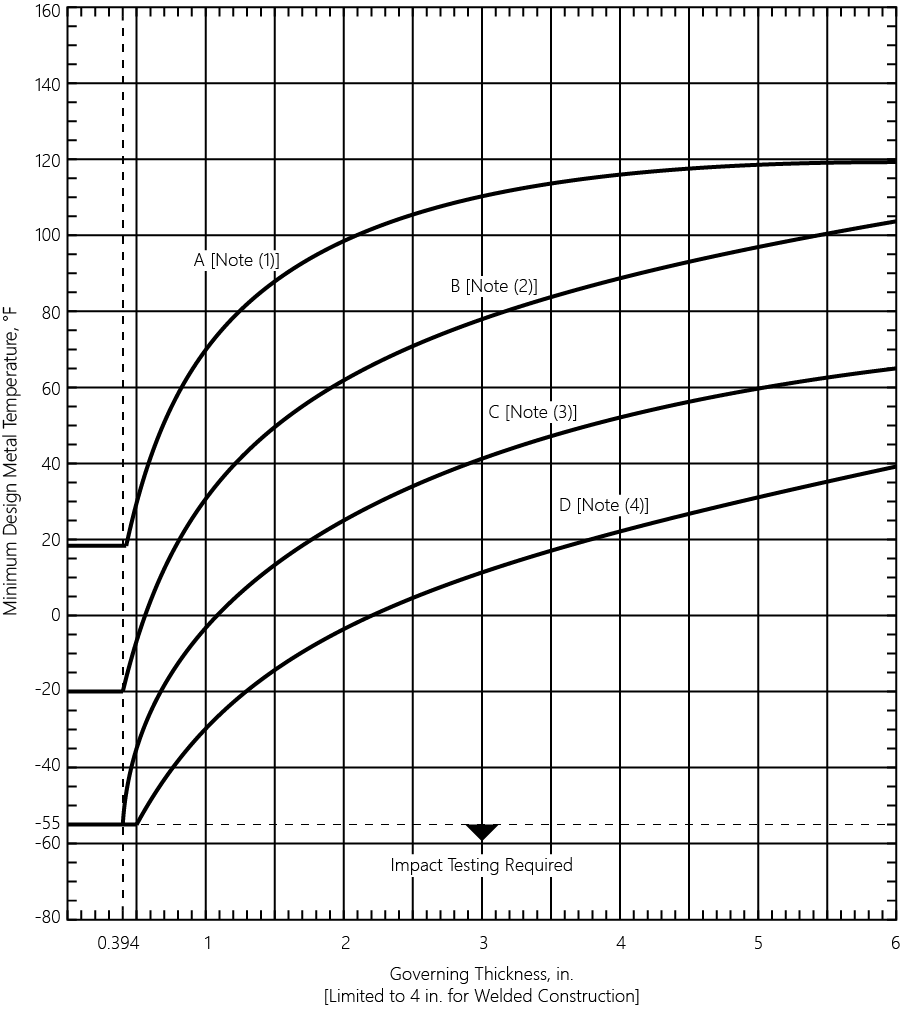
According to Figure UCS-66, SA-516 Gr70 Normalised plate falls under Curve D. Where the MDMT and thickness point is on or above Curve D, impact testing is not required. Where the point falls below Curve D, impact testing is required unless otherwise permitted by the reduction method. Bolting is not given a normal UCS-66 material curve but specified in the general notes which describes the steps for SA-320 L7M. This explains that the impact testing forms part of the material specification and does not require additional impact testing.
Charpy V-Notch Impact Testing (CIT)
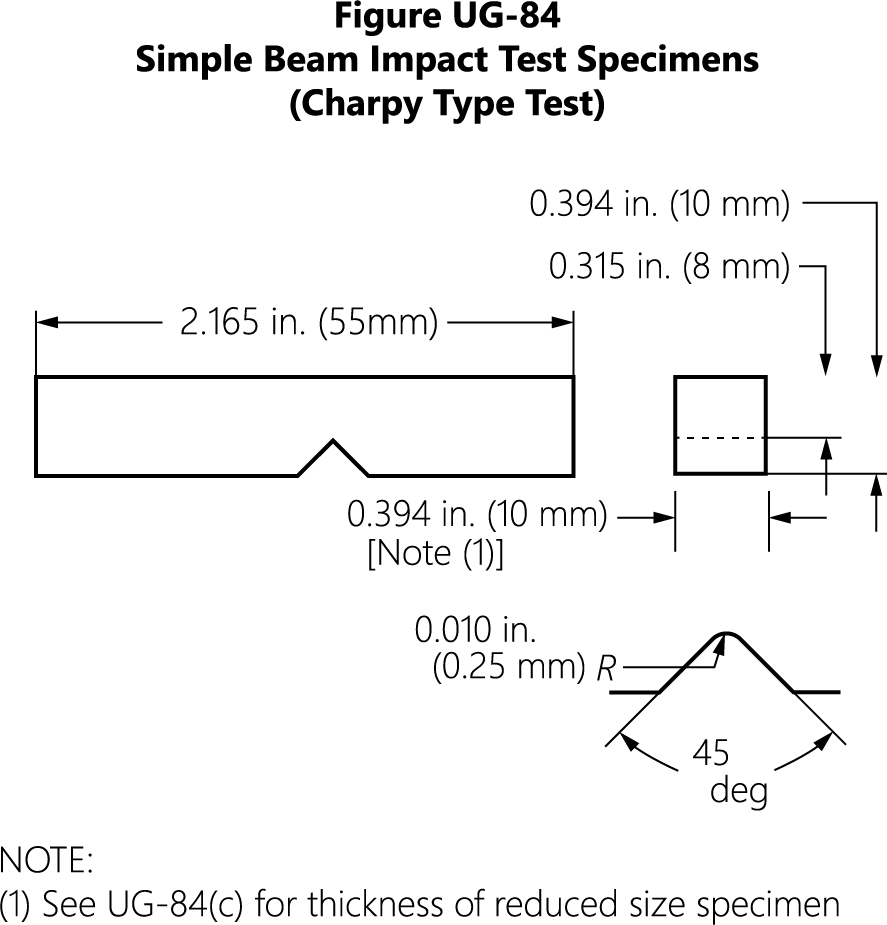
When operational temperatures fall below the curve exemption boundaries, the ASME Code, Section VIII, Paragraph UG-84 mandates a strict compliance path utilizing Charpy V-notch impact testing. This is a destructive test that evaluates material toughness and shock-load absorption at low temperatures, determining the transition point between ductile and brittle failure. Testing is performed on three specimens that are typically machined to standard 10 mm × 10 mm × 55 mm dimensions with a 2 mm, 45° groove. The specimens should represent the base metal, all weld metal, or the heat-affected zone (HAZ), with weld samples often extracted from the root area.
Tests must occur at or below the calculated Minimum Design Metal Temperature (MDMT) using specimens in a final heat-treated condition. The mandatory testing parameters recorded from the swinging hammer device are absorbed energy, lateral expansion, and percent shear. For carbon steels with a minimum specified tensile strength less than 650 MPa, the minimum acceptable absorbed energy baseline ranges from 20 joules to 27 joules. The average of the three specimens must meet these criteria while one specimen may drop to two-thirds of the required average, any further deviation constitutes a failure, necessitating a three-specimen retest.
Metallurgical & Sour Service Requirements
Hardness Thresholds and Chemistry Control (NACE MR0175/ISO 15156)
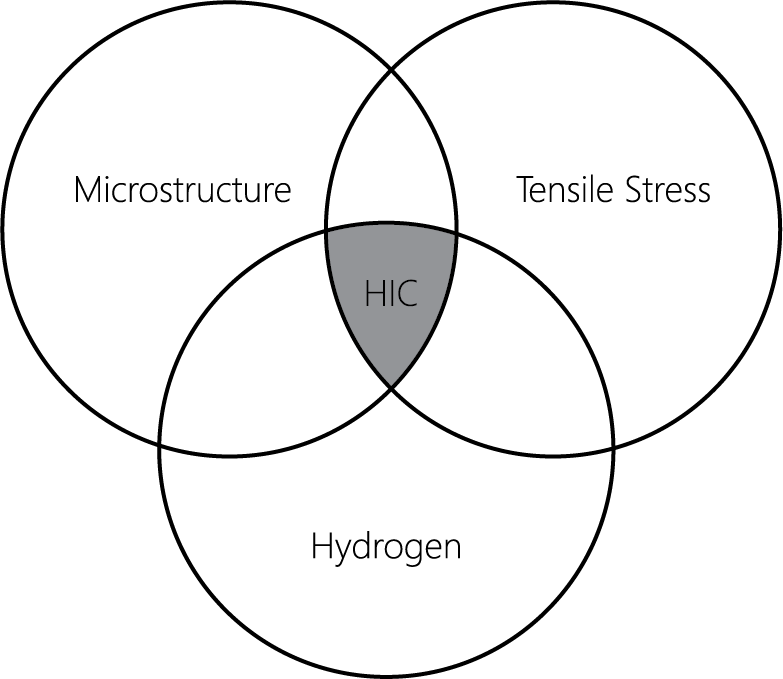
Materials exposed to wet H₂S are vulnerable to hydrogen induced corrosion due to a chemical reaction at the steel’s surface. In normal conditions, atomic hydrogen can recombine into molecular hydrogen gas and leave the surface. In wet H₂S service the sulphide suppresses this recombination reaction which allows the hydrogen to enter the steel on a molecular level. Once inside the material, the hydrogen tends towards any micro defects in the material and regions of high tensile or residual stress. The regions are formed throughout the materials lifespan such as in original forming process or heat-affected zone during manufacturing. API 579-1 describes HIC as laminar cracking in carbon steel plates exposed to aqueous hydrogen-charging environments such as H₂S, where atomic hydrogen collects at inclusions or imperfections and forms hydrogen molecules that cannot diffuse out of the steel.
For a TLSD, the cavity around the leak can create a localized wet H₂S environment. At low temperature, the risk becomes more severe because material toughness is reduced while hydrogen remains trapped at the weakened regions. This means the design must address both ASME low-temperature brittle fracture and sour-service cracking resistance as linked failure modes.
Sour-Service Metallurgical Requirements
To prevent the mechanisms of Sulphide Stress Cracking (SSC) and Hydrogen-Induced Cracking (HIC), the material selection must consider over normal pressure design strength requirements. ASME/API sources both confirm that wet hydrogen sulphide service is associated with HIC and SSC concerns. ASME B31.3 notes that for wet H₂S exposure a maximum hardness limit is usually specified by NACE MR0175/ISO 15156-2. For this TLSD case, the NACE specific limits below are retained from the supplied project guideline and shall be verified against the original NACE MR0175/ISO 15156 Part 2.
Carbon and low-alloy steel materials such as SA-516 Gr. 70 needs a hardness to be a maximum of 22 HRC. This limit must apply to the entire design such as weld root, deposited weld metal, and the peak-hardness region of the HAZ. Nickel content is also limited because a nickel-bearing low-alloy steels can show increased SSC sensitivity in certain low-temperature sour environments.
Material Selection for TLSD Components
For a TLSD in a low temperature and wet sour service environment material strategy must satisfy two independent criteria. A low temperature toughness check under ASME Section VIII Division 1 and sour service cracking resistance under the NACE specification. Regarding the low-temperature case, SA-516 Gr. 70 normalised plate is preferred because normalised SA-516 plate has a lower MDMT requirement as it uses UCS-66 Curve D for impact testing exemption. This means the normalised SA-516 is a preferred choice against Low-Temperature Brittle Fracture when compared to its non-normalised equivalent. This is because the normalising heat treatment refines the grain structure improving toughness.
For the wet sour service environment SA-516 Gr. 70, the material specification should also include normalisation, applicable impact test requirements, sour-service chemistry controls, and NACE TM0284 HIC testing where required by the client or service basis.
For bolting, SA-320 Grade L7M is preferred over standard high-strength bolting because it is hardness controlled for sour service and is intended for low-temperature bolting applications. ASME VIII-1 also identifies SA-320 L7/L7M bolting separately in the UCS-66 bolting notes rather than treating it as ordinary plate material.
Critical Bolting Choice for Cold Sour Service
Bolting is a critical failure point in cold wet H₂S service because a TLSD depends on sustained preload while the bolt material is simultaneously exposed to tensile stress and HIC. Standard high-strength fasteners such as SA193 Grade B7 or SA320 Grade L7 should not be substituted without a sour-service review. These grades can exceed the previously mentioned 22 HRC hardness sour-service requirement, making them more susceptible to SSC. API 579-1 also notes that SSC and hydrogen embrittlement are generally associated with high-strength or high-hardness steels.
For this reason, SA320 Grade L7M is the preferred choice for TLSD in this scenario. The lower strength of L7M compared with L7 or B7 can be a disadvantage in the bolting calculation due to significantly lower allowable stress. Although this disadvantage can create design challenges for engineers, the advantages of the resistance of the challenging conditions outweigh this.
