

Owen Diesel is a mechanical engineer at Beruseal with a strong background in engineering design and problem solving.
With a solid foundation in engineering principles, project management and health and safety standards, allows he contributes to the development of reliable solutions that support critical leak sealing applications at Beruseal and provides understanding to the complete impact for leak sealing beyond the purpose of just “sealing a leak”.

Understanding the Health and Safety Hierarchy
International codes such as ASME Section VIII Division 1 and ASME PCC-2 provide recognised technical methods for pressure containment and repair. However, it is easily overlooked that local legislation overrides the code. ASME Section VIII Division 1 states “Where conflicts between the Code and local or national laws or regulations occur, the laws or regulations shall govern”.
In a South African context, the legal authority governing Pressure Equipment is the Pressure Equipment Regulations (PER). The PER is a subordinate legislation to the OHSA Act (Act 85 of 1993). The requirements specified are mandatory and enforceable. The PER also makes use a national standard, SANS 347, which makes compliance with SANS 347 legally mandatory for pressure equipment within its scope.
The functional relationship between the three is the OSHA Act. Which grant government authority to regulate safety matters. This then enables PER which sets the mandatory legal requirements for pressure equipment such as enforcing SANS 347. SANS 347 then provides the technical details on classification and conformity assessment requirements of pressure equipment.
A solution can be ASME code complaint and technically sound however can still fail legally if not compliant to local jurisdictional requirements.
Engineering and Manufacturing Design Codes
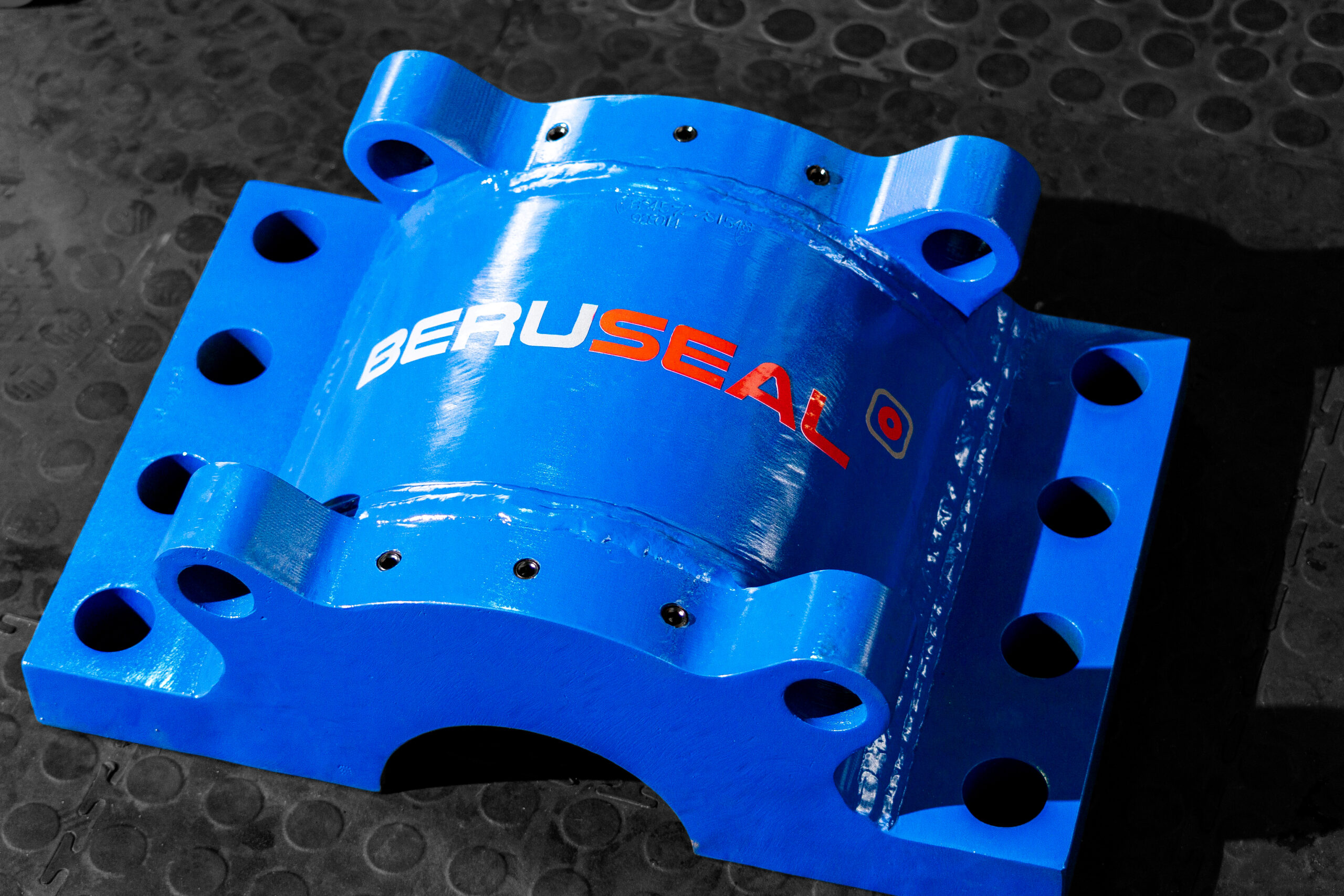
TLSDs Are Treated as Pressure Containing Components
A TLSD must be designed as a pressure containing enclosure with defined parameters and documented assumptions from both the client and designer.
Typical design considerations include:
- Design pressure
- Design temperature
- Service type
- Installation foresight and feasibility
- Nature of defect
- TLSD Material choice
- Injectable compound choice
- Axial restraint conditions
- Thermal expansion
These considerations allow the designer to develop a safe and fully complaint design, providing a sound understanding of the full scope of conditions on site. The design is not under isolated theoretical conditions and requires the designer to understand the conditions of the live leak with creating a TLSD.
As the designs are code complaint, this inherently means that the design has a built in “safety factor”. A safety factor in engineering expresses how much stronger a system is than it needs to be for its specified maximum load. ASME Section VIII Division 1 has a safety factor of roughly 3.5 of the Tensile Strength which can seem like a significant safety factor but further expresses the level of safety that goes into pressure vessel design compared to other areas of engineering.
Independent Verification as a Safety Control in Design
Independent Verification of leak sealing design is a critical step in TLSD and pressure vessel design. It acts as the primary risk mitigation barrier before manufacturing begins. There is again a difference between code and local jurisdiction. Under ASME, the competence of the design is the sole responsibility of the manufacturer/designer where verification is achieved through internal quality controls and an Approved Inspection Authority (AIA) where required. When only considering ASME the level of independent review is mainly client/contract driven.
The contrast from SANS 347 is that the standard explicitly requires independent design verification. This requirement is driven by the hazard category and assessment module for the equipment in SANS 347. For example, a design categorised as sound engineering practice (SEP) job that does not enforce an assessment module will not need any Independent Verification. But a design with a hazard category III and assessment module G will require a Professional Registered Engineer (PR Eng) sign-off, a design verification on the design calculations and AIA involvement throughout the manufacturing process.
Managing Known Failure Modes
Another direct design consideration that can drive safety in TLSD’s is looking at the most common failure modes, a few are:
- Corrosion Allowance: To manage the corrosion, a design is given additional thickness on the calculated values to account for service corrosion and the uncertain internal environment a TLSD can create.
- Joint Efficiency: To manage the reduced strength of welded joints compared to the base material, ASME incorporates a joint efficiency. A joint efficiency is a design choice that affects element thickness and the extent of Non-destructive examination (NDE) on welds. A lower joint efficiency results in increases thickness but reduces inspections whereas a higher joint efficiency reduces thickness but demands higher degree
- of NDE.
Brittle Fracture Control: To manage the risk of fracture at low temperatures, ASME requires the design to calculate a Minimum Design Metal Temperature (MDMT). This helps verify the materials toughness at that temperature typically through impact testing - SSC and HIC: To manage Sulphide Stress Cracking (SSC) and Hydrogen-Induced Cracking (HIC) in sour service environments, the designer can specify tested material and post weld heat treatment (PWHT) which can combat the effects of the sour environment on the TLSD.
Full Material Traceability
Beruseal TLSD’s are supplied with EN 10204 3.1 or 3.2 material certificates (depending on client specific requirements), ensuring chemical composition and mechanical properties are verified and traceable.
NDE/NDT Regime Before Deployment
Each TLSD undergoes inspection as specified by the requirements discussed, some examples include Dye Penetrant Testing (PT) and Magnetic Particle Inspection (MPI) as a surface examination with Ultrasonic Testing (UT) and Radiography (RT) as typical volumetric examination.
Installation on Live Systems: Controlling the Highest-Risk Phase
Competency in Execution
The installation phase is typically the point of highest direct risk to health and safety because work is performed on a live system. Beruseal controls this through a structured competency ladder. A structured approach ensures that the hazard is recognised and authority increases with technician level from supervised execution at Level 1, to field risk control at Level 2, and finally to Level 3 for oversight and authority of the overall safety and makes go/no-go decisions.
- Level 1: Operates as a controlled field technician. They are competent to work safely around live leaks by following permits, toolbox talks, PPE requirements, exclusion zones, and supervision instructions, and by using correct basic tools and handling compounds safely. They are expected to recognise obvious hazards and stop/raise concerns rather than improvise.
- Level 2: Operates as a lead for job execution. Competent to apply risk controls in the field, including site hazard assessment, enforcing a safe approach, and managing injection steps with defined emergency plans. They can conduct task-based risk assessments, control ignition sources, and ensure compliance with method statements and procedures under a permit-to-work system.
- Level 3: Operates as the technical authority for leak sealing activities. Competent to assess the safety conditions: evaluate hazard severity and escalation risk, confirm repair feasibility, define method statements and hold points, and ensure compliance with required standards and verification steps. Responsible for go/no-go decisions for installations and overall leadership of safe execution.
Site Controls and PPE
Site safety controls involve implementing a hierarchy of measures. These are elimination, substitution, engineering controls, administrative controls, and PPE which manage risks
Standard controls include:
- Standard Beruseal leak sealing equipment and Standard PPE
- A Barrier around the worksite
Full-face visors and hearing protection as baseline
For higher-risk services, additional controls may include:
- Fire-resistant coveralls
- Gas detection
- Self-Contained Breathing Apparatus
Auditable Safety
A leak sealing solution must be easily auditable. Each job should produce a structured data pack, typically including:
- Design calculations and assumptions
- Manufacturing Drawing
DVE and AIA approvals (if applicable) - Material certificates
- NDE/NDT reports
- Pre and post installation records
- Installation method statements
- Riks assessments
